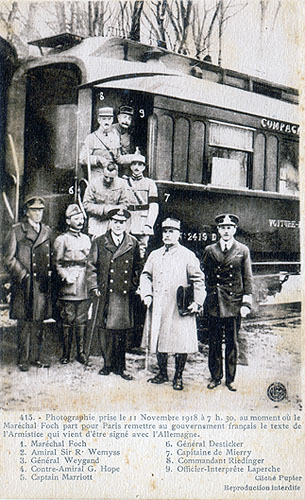

Terms of the Armistice With Germany,
Signed November 11, 1918
Between Marshal Foch commander in chief of the allied armies, acting in the name of the allied and associated powers, with Admiral Wemyss, first sea lord, on the one hand, and Herr Erzberger, secretary of state, president of the German delegation, Count von Oberndorff, envoy extraordinary and minister plenipotentiary, Maj. Gen. von Winterfeldt, Capt. Vanselow (German navy), duly empowered and acting with the concurrence of the German chancellor, on the other hand.
An armistice has been concluded on the following conditions:
Conditions of the Armistice Concluded with Germany
(A) CLAUSES RELATING TO THE WESTERN FRONT
I. Cessation of hostilities by land and in the air six hours after the signing of the armistice.
II. Immediate evacuation of the invaded countries-Belgium, France, Luxemburg, as well as Alsace-Lorraine--so ordered as to be completed within 15 days from the signature of the armistice.
German troops which have not left the above-mentioned territories within the period fixed shall be made prisoners of war.
Occupation by the allied and United States forces jointly shall keep pace with the evacuation in these areas.
All movements of evacuation and occupation shall be regulated in accordance with a note (Annexe 1) determined at the time of the signing of the armistice.
III. Repatriation, beginning at once, to be completed within 15 days, of all inhabitants of the countries above enumerated (including hostages, persons under trial, or condemned).
IV. Surrender in good condition by the German armies of the following equipment: 5,000 guns (2,500 heavy, 2,500 field), 25,000 machine guns, 3,000 trench mortars, 1,700 aeroplanes (fighters, bombers-firstly all D. 7s and night-bombing machines).
The above to be delivered in situ to the allied and United States troops in accordance with the detailed conditions laid down in the note (Annexe 1) determined at the time of the signing of the armistice.
V. Evacuation by the German armies of the districts on the left bank of the Rhine. These districts on the left bank of the Rhine shall be administered by the local authorities under the control of the allied and United States armies of occupation.
The occupation of these territories by allied and United States troops shall be assured by garrisons holding the principal crossings of the Rhine (Mainz, Coblenz, Cologne), together with bridgeheads at these points of a 30-kilometer (about 19 miles) radius on the right bank, and by garrisons similarly holding the strategic points of the area.
A neutral zone shall be reserved on the right bank of the Rhine, between the river and a line drawn parallel to the bridgeheads and to the river and 10 kilometers (6 ¼ miles) distant from them, between the Dutch frontier and the Swiss frontier.
The evacuation by the enemy of the Rhine districts (right and left banks) shall be so ordered as to be completed within a further period of 16 days, in all 31 days after the signing of the armistice.
All movements of evacuation and occupation shall be regulated according to the note (Annexe 1) determined at the time of the signing of the armistice.
VI. In all territories evacuated by the enemy, evacuation of the inhabitants shall be forbidden; no damage or harm shall be done to the persons or property of the inhabitant.
No person shall be prosecuted for having taken part in any military measures previous to the signing of the armistice.
No destruction of any kind to be committed.
Military establishments of all kinds shall be delivered intact, as well as military stores, food, munitions, and equipment, which shall not have been removed during the periods fixed for evacuation.
Stores of food of all kinds for the civil population, cattle, etc., shall be left in situ.
No measure of a general character shall be taken, and no official order shall be given which would have as a consequence the depreciation of industrial establishments or a reduction of their personnel.
VII. Roads and means of communications of every kind, railroads, waterways, roads, bridges, telegraphs, telephones, shall be in no manner impaired.
All civil and military personnel at present employed on them shall remain.
Five thousand locomotives and 150,000 wagons, in good working order, with all necessary spare parts and fittings, shall be delivered to the associated powers within the period fixed in Annexe No. 2 (not exceeding 31 days in all).
Five thousand motor lorries are also to be delivered in good condition within 36 days.
The railways of Alsace-Lorraine shall be handed over within 31 days, together with all personnel and material belonging to the organization of this system.
Further, the necessary working material in the territories on the left bank of the Rhine shall be left in situ.
All stores of coal and material for the upkeep of permanent way, signals, and repair shops, shall be left in situ and kept in an efficient state by Germany, so far as the working of the means of communication on the left bank of the Rhine is concerned.
All lighters taken from the Allies shall be restored to them.
The note attached as Annexe 2 defines the details of these measures.
VIII. The German command shall be responsible for revealing within 48 hours after the signing of the armistice all mines or delay-action fuses disposed on territories evacuated by the German troops, and shall assist in their discovery and destruction.
The German command shall also reveal all destructive measures that may have been taken (such as poisoning or pollution of wells, springs, etc.).
Breaches of these clauses will involve reprisals.
IX. The right of requisition shall be exercised by the allied and United States armies in all occupied territories, save for settlement of accounts with authorized persons.
The upkeep of the troops of occupation in the Rhine districts (excluding Alsace-Lorraine) shall be charged to the German Government.
X. The immediate repatriation, without reciprocity, according to detailed conditions which shall be fixed, of all allied and United States prisoners of war, including those under trial and condemned. The allied powers and the United States of America shall be able to dispose of these prisoners as they think fit. This condition annuls all other conventions regarding prisoners of war, including that of July, 1918, now being ratified. However, the return of German prisoners of war interned in Holland and Switzerland shall continue as heretofore. The return of German prisoners shall be settled at the conclusion of the peace preliminaries.
XI. Sick and wounded who can not be removed from territory evacuated by the German forces shall be cared for by German personnel, who shall be left on the spot with the material required.
(B) CLAUSES RELATING TO THE EASTERN FRONTIERS OF GERMANY
XII. All German troops at present in any territory which before the war formed part of Austria-Hungary, Roumania, or Turkey, shall withdraw within the frontiers of Germany as they existed on August 1, 1914, and all German troops at present in territories which before the war formed part of Russia must likewise return to within the frontiers of Germany as above defined, as soon as the Allies shall think the moment suitable, having regard to the internal situation of these territories.
XIII. Evacuation of German troops to begin at once, and all German instructors, prisoners and agents, civilians as well as military, now on the territory of Russia (frontiers as defined on Aug. 1, 1914), to be recalled.
XIV. German troops to cease at once all requisitions and seizures and any other coercive measures with a view to obtaining supplies intended for Germany in Roumania and Russia (frontiers as de- fined on Aug. 1, 1914).
XV. Annulment of the treaties of Bucharest and Brest-Litovsk and of the supplementary treaties.
XVI. The Allies shall have free access to the territories evacuated by the Germans on their eastern frontier, either through Danzig or by the Vistula, in order to convey supplies to the populations of these territories or for the purpose of maintaining order.
(C) CLAUSE RELATING TO EAST AFRICA
XVII. Evacuation of all German from operating in East Africa within a period specified by the Allies.
(D) GENERAL CLAUSES
XVIII. Repatriation without reciprocity, within a maximum period of one month, in accordance with detailed conditions hereafter to be fixed, of all interned civilians, including hostages and persons under trial and condemned, who may be subjects of allied or associated States other than those mentioned in Clause III.
FINANCIAL CLAUSES
XIX. With the reservation that any subsequent concessions and claims by the Allies and United States remain unaffected, the following financial conditions are imposed:
Reparation for damage done.
While the armistice lasts no public securities shall be removed by the enemy which can serve as a pledge to the Allies to cover reparation for war losses.
Immediate restitution of the cash deposit in the National Bank of Belgium and, in general, immediate return of all documents, specie, stocks, shares, paper money, together with plant for the issue thereof, affecting public or private interests in the invaded countries.
Restitution of the Russian and Roumanian gold yielded to Germany or taken by that power.
This gold is to be delivered in trust to the Allies until peace is concluded.
(E) NAVAL CONDITIONS
XX. Immediate cessation of all hostilities at sea and definite information to be given as to the position and movements of all German ships.
Notification to be given to neutrals that freedom of navigation in an territorial waters is given to the navies and mercantile marines of the allied and associated powers, all questions of neutrality being waived.
XXI. All naval and mercantile marine prisoners of war of the allied and associated powers in German hands to be returned without reciprocity.
XXII. To surrender at the ports specified by the Allies and the United States all submarines at present in existence (including all submarine cruisers and mine layers), with armament and equipment complete. Those that can not put to sea shall be deprived of armament and equipment and shall remain under the supervision of the Allies and the United States. Submarines ready to put to sea shall be prepared to leave German ports immediately on receipt of a wireless order to sail to the port of surrender, the remainder to follow as early as possible. The conditions of this article shall be completed within 14 days of the signing of the armistice.
XXIII. The following German surface warships, which shall be designated by the Allies and the United States of America, shall forthwith be disarmed and thereafter interned in neutral ports, or, failing them, allied ports, to be designated by the Allies and the United States of America, and placed under the surveillance of the Allies and the United States of America, only care and maintenance parties being left on board, namely:
- 6 battle cruisers.
- 10 battleships.
- 8 1ight cruisers (including 2 mine layers).
- 50 destroyers of the most modern type.
All other surface warships (including river craft) are to be concentrated in German naval bases, to be designated by the Allies and the United States of America, completely disarmed and placed under the supervision of the Allies and the United States of America. All vessels of the auxiliary fleet are to be disarmed. All vessels specified for internment shall be ready to leave German ports seven days after the signing of the armistice. Directions for the voyage shall be given by wireless.
XXIV. The Allies and the United States of America shall have the right to sweep up all mine fields and destroy all obstructions laid by Germany outside German territorial waters, and the positions of these are to be indicated.
XXV. Freedom of access to and from the Baltic to be given to the navies and mercantile marines of the allied and associated powers. This to be secured by the occupation of all German forts, fortifications, batteries, and defense works of all kinds in all the routes from the Cattegat into the Baltic and by the sweeping up and destruction of all mines and obstructions within and without German territorial waters without any questions of neutrality being raised by Germany, and the positions of all such mines and obstructions to be indicated, and the plans relating thereto are to be supplied.
XXVI. The existing blockade conditions set up by the allied and associated powers are to remain unchanged, and all German merchant ships found at sea are to remain liable to capture. The Allies and United States contemplate the provisioning of Germany during the armistice as shall be found necessary.
XXVII. All aerial forces are to be concentrated and immobilized in German bases to be specified by the Allies and the United States of America.
XXVIII. In evacuating the Belgian coasts and ports Germany shall abandon in situ and intact the port material and material for inland waterways, also all merchant ships, tugs and lighters, all naval aircraft and air materials and stores, all arms and armaments and all stores and apparatus of all kinds.
XXIX. All Black Sea ports are to be evacuated by Germany; all Russian warships of all descriptions seized by Germany in the Black Sea are to be handed over to the Allies and the United States of America; all neutral merchant ships seized in the Black Sea are to be released; all warlike and other materials of all kinds seized in those ports are to be returned, and German materials as specified in Clause XXVIII are to be abandoned.
XXX. All merchant ships at present in German hands belonging to the allied and associated powers are to be restored to ports specified by the Allies and the United States of America without reciprocity.
XXI. No destruction of ships or of materials to be permitted before evacuation, surrender, or restoration.
XXII. The German Government shall formally notify all the neutral Governments, and particularly the Governments of Norway, Sweden, Denmark, and Holland, that all restrictions placed on the trading of their vessels with the allied and associated countries, whether by the German Government or by private German interests, and whether in return for specific concessions, such as the export of shipbuilding materials, or not, are immediately canceled.
XXIII. No transfers of German merchant shipping of any description to any neutral flag are to take place after signature of the armistice.
(F) DURATION OF ARMISTICE
XXIV. The duration of the armistice is to be 36 days, with option to extend. During this period, on failure of execution of any of the above clauses, the armistice may be repudiated by one of the contracting parties on 48 hours' previous notice. It is understood that failure to execute Articles III and XVIII completely in the periods specified is not to give reason for a repudiation of the armistice, save where such failure is due to malice aforethought.
To insure the execution of the present convention under the most favorable conditions, the principle of a permanent international armistice commission is recognized. This commission shall act under the supreme authority of the high command, military and naval, of the allied armies.
The present armistice was signed on the 11th day of November, 1918, at 5 o'clock a. m. (French time).
F. Foch
R. E. Wemyss
Erzberger
Oberndorff
Winterfeldt
Vanselow
November 11, 1918
The, representatives of the Allies declare that, in view of fresh events, it appears necessary to them that the following condition shall be added to the clauses of the armistice:
In case the German ships are not handed over within the periods specified, the Governments of the Allies and of the United States shall have the right to occupy Heligoland to insure their delivery.
F. Foch
R. E. Wemyss, Admiral
The German delegates declare that they will forward this declaration to the German chancellor, with the recommendation that it be accepted, accompanying it with the reasons by which the Allies have been actuated in making this demand.
Erzberger
Oberndorff
Winterfeldt
Vanselow