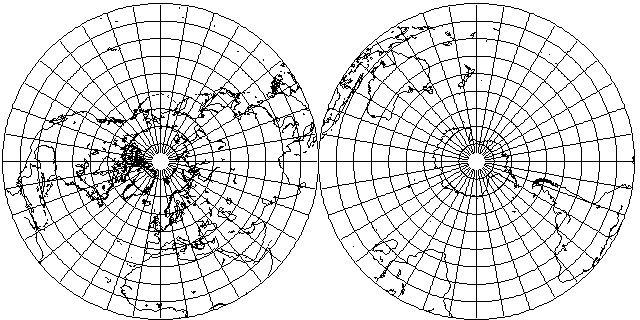
This is a slightly different way of looking at the globe. It's actually a map that is usually called a polar projection with the northern hemisphere on the left and the southern on the right. (If most of the globe's land mass is in the north, won't the earth flip around one day?)

These days you will often hear phrases such as "global economy," "world culture" or "multi-national corporations" thrown about in conversations or spoken of on the news, indicating some ongoing thing called "globalization." But what does that mean? Before I offer some scattered remarks about "globalization," let's first look at three definitions.
Globalization or (globalisation) in its literal sense is the process of making, transformation of some things or phenomena into global ones. It can be described as a process by which the people of the world are unified into a single society and function together. This process is a combination of economic, technological, sociocultural and political forces. (formerly on Wikipedia)
the growing integration of economies and societies around the world (youthink.worldbank.org/issues/globalization/index.php)
Covering a wide range of distinct political, economic, and cultural trends, the term “globalization” has quickly become one of the most fashionable buzzwords of contemporary political and academic debate. In popular discourse, globalization often functions as little more than a synonym for one or more of the following phenomena: the pursuit of classical liberal (or “free market”) policies in the world economy (“economic liberalization”), the growing dominance of western (or even American) forms of political, economic, and cultural life (“westernization” or “Americanization”), the proliferation of new information technologies (the “Internet Revolution”), as well as the notion that humanity stands at the threshold of realizing one single unified community in which major sources of social conflict have vanished (“global integration”). Fortunately, recent social theory has formulated a more precise concept of globalization than those typically offered by pundits. Although sharp differences continue to separate participants in the ongoing debate, most contemporary social theorists endorse the view that globalization refers to fundamental changes in the spatial and temporal contours of social existence, according to which the significance of space or territory undergoes shifts in the face of a no less dramatic acceleration in the temporal structure of crucial forms of human activity. Geographical distance is typically measured in time. As the time necessary to connect distinct geographical locations is reduced, distance or space undergoes compression or “annihilation.” The human experience of space is intimately connected to the temporal structure of those activities by means of which we experience space. Changes in the temporality of human activity inevitably generate altered experiences of space or territory. Theorists of globalization disagree about the precise sources of recent shifts in the spatial and temporal contours of human life. Nonetheless, they generally agree that alterations in humanity's experiences of space and time are working to undermine the importance of local and even national boundaries in many arenas of human endeavor. Since globalization contains far-reaching implications for virtually every facet of human life, it necessarily suggests the need to rethink key questions of normative political theory. (Stanford Encyclopedia of Philosophy)
I included the last definition, even though it is a long one, because there are some important points made, beginning with the comment that "globalization" often functions as little more than a buzz word for some ill-defined ideas. The other point that I find fascinating is the idea of the annihilation of space/time boundaries--that sounds like something out of Star Trek and the space-time continuum. You can see this "annihilation" any time that you are surfing on the computer or watching TV, but it is also evident as some virulent strain of avian flu makes its way across the Eurasian continent.
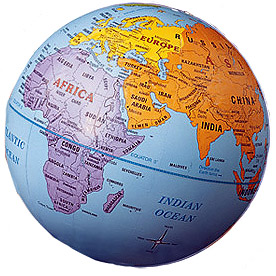
In my view, the world "globalization" process/revolution of the late twentieth century mirrors, in many interesting respects, almost exactly the western modernization revolution of the late nineteenth century. I have no answer to the question that I'm about to ask, but I will pose it anyway: Are globalization and modernization the same? Maybe someone would like to tackle that question in an extra credit essay (two-pages; cite your sources)?
Anyway, consider these comparison points between nineteenth-century modernization and twentieth-century globalization.
- the driving force of technology and the introduction of technological marvels in both cases: the electric light, automobile, phonograph, telephone versus the transistor, jet airplanes, rocketry, television, computer, cell phone, plastics, etc.
- agricultural improvements: the mechanization of agriculture, improved seeds and farming practices leading to dramatic increases in production
- industrial mass production leading to cheap goods for the masses (manned assembly lines in 1910 against robotic or automated assembly lines currently)
- a shift in the world's political-economic center from Europe to Americas circa 1900; now a shift in the center from the Americas to Asia
- a population explosion in both cases (both population and life expectancy increased as a result of medical advances and better nutrition)
- communication advances that lead to a dramatic "annihilation of temporal boundaries"!
- spread of education and general increases in adult literacy, often accompanied by enhanced political participation
- the idea of progress as a commonly accepted social and economic barometer, usually with the idea that science and technology will be able to solve any problem
Let's continue the comparison with some negatives from both cases.
- the dark side of environmental degradation. The pollution of the late industrial era in the West was unbelievable. While the sun does not quite get blacked out anymore in America's east coast industrial cities, it still does in some cities in China, including Beijing. There is the imminent threat of global warming also today.
- With the spread of education and the instant communications now available, it is not surprising that most people in the world are aware of the idea of human rights, but the guarantee of human rights to all populations of the world remains problematic. See my additional remarks on Human Rights.
- The arms race was going on in full force at the turn of the twentieth century, eventually becoming a contributing factor to the outbreak of World War I, and there is still massive arms proliferation in the modern world today. The nuclear club has expanded, and biological/chemical weapons are still around.
- assassination (a number of political leaders including the American President William McKinley in September 1901 and the Italian King Umberto I in July 1900) and terrorism
- Urbanization and the dramatic growth of the world's cities. Today there are quite a few cities that number over twelve million inhabitants including Mumbai and Karachi.
- continual warfare somewhere in the world, in both 1900 and 2000 that place was Africa
- The increasing scale of unequal wealth distribution (then and now).
What of the politics of the global community?
Well, with the demise of the bipolar environment of the Cold War, some have wondered whether a truly global political structure can now come into being. The most relevant attempt at large-scale, global governmental cooperation, or a multi-national governing body, is the United Nations (UN), which has enjoyed, at best, mixed success since it was created in the last years of the Second World War--51 countries signed the original charter in San Francisco in early June 1945. Despite many political difficulties over the years, the UN has managed to send peacekeeping forces to places like Korea, Cyprus, the Belgian Congo, Iraq, Kuwait, Bosnia and so on, but the high hopes that some officials had for the UN to become a world government have never been quite fulfilled. Moreover, the UN has been relatively unsuccessful in preventing violence. More moderate success has been achieved in non-political areas by UN-type organizations such as UNESCO or the WHO.
A global economy? Global cooperation has been clearly present in the economic arena through such organizations as the IMF (International Monetary Fund), the World Bank; GATT (General Agreement on Tariffs and Trade), the European Economic Community (EEC) or other regional agreements such as NAFTA (North American Free Trade Agreement).
What of a world or global culture? Are the Beatles or U-2 part of a world culture? Is there such as thing as a global mass culture? See my Pop Culture assignment.
The spiritual world? Has the dehumanization of the modern world occurred? Is the world more impersonal today than it was a hundred years ago (I doubt it.)? If so, does that lead to the the appeal of charismatic leaders and the onset of demagogic politics? Have you checked out the "spirituality" section of the library or your local bookstore recently?
Is life better in the world than it was thirty years ago? If many assume that the quality of life is declining--Sorry, but my grandmother would, if she were still alive, disagree. She would just tell you to look at the automatic washing machine, not to mention air conditioning, as clear proof that life was getting better--anyway that idea that the quality (not necessarily quantity) of life is declining may be accounted for by a rise in expectations. Many around the world now expect a better life and "fulfillment" of their wishes and dreams with the realization that that fulfillment is almost within their grasp.
Isn't the label on this bottle of hot chili sauce evidence enough of a global society? I think that the global/modernization process of the last few decades has resulted in an ambiguous present and an unclear future. On one hand, millions of people around the word have opportunities that they did not have just a few decades ago. On the other hand, millions of people around the world do not have guarantees of basic human rights and still live in brutal conditions. Think diamond mines in Sierra Leone. In addition, what were once isolated problems, such as a civil war in a small African country or some chickens dying in a village in Thailand, have become global problems. I think that in itself is the essence of what globalization is, with both its pluses and minuses.

Web pages within the course relevant to globalization
- Henry Kissinger
- Richard Nixon
- Camp David Accords
- Kent State Shootings
- Earth Day
- Bangladesh
- Landsat
- Mao Zedong
- The PC Revolution
- Afghanistan
- Iranian Revolution
- Global Population Growth in Modern History
Some suggestions for further research
- Hans Rosling's 200 Countries, 200 Years (the Joy of Stats) This quick video on YouTube takes a look at health/wealth data over the past two centuries to illustrate the development of the global world.
- Global Development Network offers publications on topics of the developing world and provides information on major development topics.